
The ESG Myths Costing Dutch SMEs Contracts, Loans, and Good Hires
Updated: Mar 16
Small businesses across the Netherlands think ESG is someone else's problem. Their biggest clients, banks and landlords, increasingly disagree.

Last spring, a logistics manager at a 40-person transport company in Utrecht opened an email from her biggest client, a mid-sized retailer, that included a supplier sustainability questionnaire. Twelve pages. Carbon emissions, social policies, governance structures, supplier codes of conduct. She forwarded it to the director, who forwarded it to the bookkeeper. Nobody answered it.
Three months later, the contract wasn't renewed.
It's a story we have heard in various versions repeatedly. As large Dutch companies come under pressure from the EU's Corporate Sustainability Reporting Directive (CSRD), they are passing that pressure down their supply chains. to suppliers such as 30-person trucking outfits, packaging companies, cleaning services, and IT contractors. Small businesses that have never thought seriously about ESG are now getting twelve-page questionnaires with no warning.
The frustrating part is that most of these businesses aren't irresponsible. They are just operating on outdated assumptions about who ESG is actually for.
A 2023 global study by Sage, PwC, and the International Chamber of Commerce surveyed SMEs across 32 countries and found that while 83% said sustainability was important to their business, just 8% were formally reporting on it. Among those who have heard the term ESG, the most common response is: "That's for big companies." Until recently, they were right. That window has closed.

What ESG Actually Means for a Dutch SME
ESG for SMEs is about showing clients and banks that you run a responsible business on energy, people, and decision-making, using simple, organised evidence.
Strip away the acronyms and frameworks, and ESG is a structured way of looking at how a business affects, and is affected by, its environment, people, and governance. For a small manufacturer or logistics company, that means energy use, working conditions, supplier choices, data protection, and the way decisions are documented.
In the EU, the CSRD has raised the bar for large companies, requiring them to publish detailed sustainability disclosures. Most SMEs are not directly covered. But the European Financial Reporting Advisory Group (EFRAG), which developed the EU's voluntary SME sustainability standard, has a name for what happens next: the trickle-down effect. When a large company has to report its Scope 3 emissions or document supplier practices, it sends questionnaires to its supply chain. Those questionnaires land in SME inboxes.
In July 2025, the European Commission formally adopted a Recommendation on the new Voluntary Sustainability Reporting Standard for SMEs (VSME), a direct acknowledgement that non-listed SMEs, while not legally required to report under CSRD, face growing pressure from banks, large clients, and investors to demonstrate their sustainability credentials.
Banks are moving in the same direction. Rabobank and the European Investment Bank have jointly provided over €1.8 billion in sustainable financing to more than 1,000 Dutch SMEs through their Rabo Impactlening programme, and signed a new €300 million contract in January 2025. Rabobank's director of business clients, Carlo van Kemenade, said in the announcement: "We are noticing a considerable increase in demand for sustainable financing."
For SMEs, ESG is less about glossy annual reports and more about ESG reporting for small and medium-sized businesses in the Netherlands that simply explains, with basic evidence, how the business operates. The myths arise when SMEs assume that, because they're not sustainability leaders, the topic doesn't apply to them, or that engaging with it creates only costs and paperwork.
If you want a simple overview of how this works in practice, see our page on ESG and green workplaces for small teams with limited time.
The Myths and What They Are Really Costing
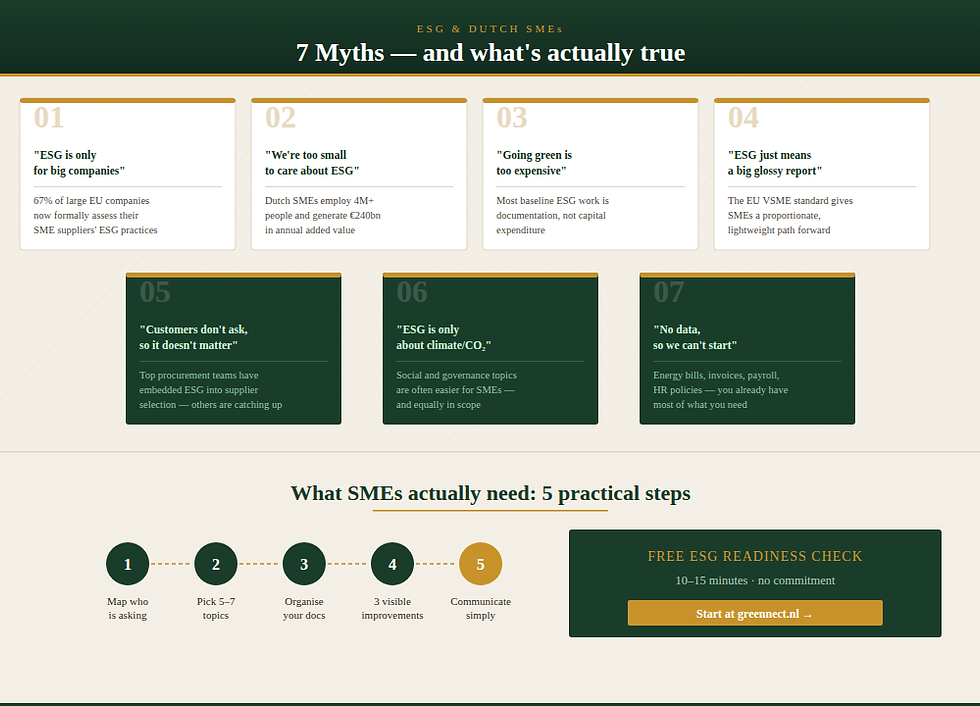
Myth 1: "ESG is only for big companies"
Myth: ESG is something for listed corporations with thousands of employees, not for small firms.
The reality
This is technically true and practically irrelevant. The CSRD directly applies to large companies, those with 250 or more employees and above certain revenue thresholds. So the legal obligation rests with the bigger players.
But supply chain pressure doesn't follow legal thresholds. The growth in supplier sustainability assessments has been dramatic: EcoVadis, a leading platform for supply chain ESG ratings, saw the global number of sustainability ratings grow 167% between 2020 and 2024. More than 150,000 businesses now use its platform to assess and be assessed by their supply chain partners. Being too small to file a CSRD report doesn’t protect you from being asked to provide one.
The Utrecht transport company wasn't the only casualty. A packaging supplier in Noord-Holland with 35 employees lost a three-year contract with a food manufacturer for the same reason: the manufacturer’s CSRD disclosure required them to document supplier practices. The packaging firm had nothing on file. The contract went to a competitor who did.
We break this down step by step in ESG compliance in the Netherlands, where SMEs should actually start.
What this looks like in practice
A 15-person IT services company provides support to a multinational client. When the client updates its vendor requirements, suppliers must submit basic information on data protection, employee training, diversity, and office emissions. The IT firm that has already mapped these areas can respond within days. A competitor that treats ESG as irrelevant may spend weeks scrambling or quietly drop out of contention.
One thing to do this month: Map your three largest clients that might ask about ESG and list the topics they've mentioned, formally or informally, in the past year. Use that as your starting list, rather than trying to cover every possible ESG topic at once.
Myth 2: "We're too small to care about ESG"
Myth: A business with a few dozen employees can't meaningfully influence ESG outcomes, so the topic isn't worth attention.
The reality
"Too small" is doing a lot of work in that sentence. According to Statista, Dutch SMEs employed over four million people in 2023 and generated €240 billion in added value; they are not peripheral to the Dutch economy. They are the Dutch economy. And from the perspective of a large client, a single small supplier can still be critical: a specialist manufacturer, a design studio, a logistics partner.
Caring about ESG at a small scale doesn’t mean copying multinationals’ strategies. It means finding the handful of actions that matter most in your sector and showing you take them seriously. SMEs that rely on corporate clients, bank financing, or commercial landlords are already in environments where ESG is being measured and rewarded. Rabobank’s impact loan programme, offering interest rate discounts of up to 0.65% to SMEs with documented sustainability credentials, is a direct financial incentive to get organised.
What this looks like in practice
A 20-person creative agency may not operate factories or truck fleets, but it can make meaningful choices: reducing travel by using virtual meetings, choosing hosting providers with clear climate commitments, formalising policies on working hours and wellbeing, and publishing a short supplier code of conduct. When a corporate client asks about ESG, the agency can point to those practices rather than say, "We're too small for this."
One thing to do this month: List your top five operational decisions that affect people or the environment, energy, commuting, suppliers, waste, working conditions, and write one sentence on how you currently manage each. This exercise usually reveals that you already do more than you think.
Myth 3: "Going green is too expensive for us"
Myth: ESG and sustainability always require significant up-front investment that small firms can't afford.
The reality
I understand this one. "Sustainability" has become associated with solar panel installations, carbon accounting software, and consultants billing by the day. For a business on tight margins, the price signals are bad.
But the baseline version of ESG, what clients and banks are actually asking for, costs almost nothing to reach. Most of the work is documentation, not transformation. You are not being asked to decarbonise your operations; you are being asked to show you know what your operations look like.
Where there are real expenditures, they often pay back. The EU's Annual Report on European SMEs found that energy efficiency measures are among the most cost-effective sustainability actions available to small businesses, and that access to green financing, like Rabobank’s impact loan, can further reduce the effective cost of sustainable investments. A Dutch retailer with 80 employees cut its energy bill by 22% over two years through changes that cost under €8,000 upfront. The expensive version of ESG exists, but nobody is demanding it from SMEs.
What this looks like in practice
A 30-person co-working space reviews its energy bills and discovers that heating and cooling account for a large share of costs. This is exactly the type of quick win we focus on in our green workplace support for Dutch SMEs and co-working spaces.
By adjusting temperature settings, improving maintenance schedules, and installing basic smart controls, it reduces consumption without major capital expenditure. The space then communicates these changes to tenants as part of a broader green workplace effort, turning a cost-control exercise into a competitive asset.
One thing to do this month: Walk through your space and note five significant sources of energy use, waste, or travel. You don't have to fix them. Just know what they are.
Myth 4: "ESG just means a big, glossy report"
Myth: ESG is fundamentally about producing long, polished reports for investors and regulators.
The reality
Large companies publish sustainability reports because investors expect them and PR teams demand them. Nobody is asking your 45-person logistics company for a 60-page document with infographics and a CEO letter.
What procurement teams actually want is answers to their specific questions, documented consistently. A one-page supplier questionnaire response. A rough carbon estimate. A short note on employee well-being policies. EFRAG's VSME standard, which the EU Commission officially endorsed in July 2025, was designed precisely to give SMEs a proportionate, manageable way to respond to these requests without building an entire reporting infrastructure.
A co-working space in Rotterdam built a two-page ESG fact sheet covering energy use, waste, supplier policies, and community work. Two days of the operations manager's time. It now goes out with every tenant proposal and has come up positively in three contract negotiations.
What this looks like in practice
A family-owned manufacturer with 40 employees receives an ESG questionnaire from a major buyer. Instead of commissioning a full report, it works through the questions, identifying which require data on energy use, occupational safety, or staff policies, then creates a simple folder to store utility bills, policy documents, and incident logs. Future requests get answered in hours, not weeks.
One thing to do this month: Create a single ESG evidence folderdigital or physical, storing energy bills, HR policies, supplier codes, and any existing sustainability documents. This alone covers most of what clients actually ask for.
Myth 5: "Our customers don't ask about ESG, so it doesn't matter"
Myth: If clients aren't actively asking sustainability questions today, ESG can be ignored.
The reality
Not asking yet. That's different from it not mattering. McKinsey's procurement benchmarking data, covering more than 2,000 companies, found that ESG integration is now a significant differentiator between top-performing and lower-performing procurement organisations. Leading procurement functions have embedded sustainability criteria into supplier selection; lower-performing organisations haven't yet, but they are under pressure to catch up.
The pressure reaches SMEs with a delay. When a large client upgrades its procurement standards, often triggered by its own CSRD obligations or investor requirements, the questions arrive suddenly. Waiting until the first questionnaire appears leaves no time to gather data or implement changes.
There's also a hiring angle that's easy to miss. The Randstad Workmonitor Pulse survey, based on more than 5,000 workers globally, found that 67% of employees cite "shared organisational values" as one of the top differentiators for staying with an employer long-term. For SMEs competing for skilled workers in a tight labour market, not having an ESG story is a disadvantage.
What this looks like in practice
A cleaning services company specialising in office buildings adopts more sustainable products and standardises health and safety training. When a property manager later updates tender criteria to include ESG elements, the company provides clear evidence of its practices while rivals scramble to adapt. Being slightly ahead of the curve strengthens relationships and creates a real differentiation.
One thing to do this month: Ask your three most important clients whether they expect ESG or sustainability questions to become part of their purchasing criteria in the next two years. Their responses tell you exactly where to focus.
Myth 6: "ESG is only about climate or CO₂"
Myth: ESG is primarily a climate conversation that doesn't apply to businesses with a modest environmental footprint.
The reality
Climate gets most of the airtime, but it's not the whole thing. ESG also covers how you treat employees, whether you have a harassment policy, how you manage supplier relationships, and whether your governance is transparent. For many SMEs, the S and G social and governance are easier to address than the E.
The Sage/PwC/ICC 2023 SME sustainability report found that SMEs taking steps toward sustainability were most commonly focused on workplace practices and supplier relationships, not just energy and carbon. More than 60% said they were already making changes, such as tweaking product lines, reducing energy use, or adjusting procurement practices. The gap is not due to effort; it's due to documentation.
What this looks like in practice
A 12-person software company may not have heavy emissions, but it handles sensitive user data and operates in a tight labour market. Its ESG priorities centre on secure coding practices, transparent governance, fair employment terms, and clear channels for reporting issues. When a potential enterprise client asks about ESG, the company highlights these strengths instead of apologising for not having a carbon footprint analysis.
One thing to do this month: Group your ESG topics into three columns: environmental, social, and governance—and list at least two items under each that already apply to your business. Most SMEs are further ahead in columns two and three than they realise.
Myth 7: "We don't have data, so we can't start"
Myth: Without detailed historical data, it's impossible to begin working on ESG.
The reality
This one frustrates me, because it's almost always wrong. Your energy supplier has annual consumption figures. Your waste contractor sends invoices. You know your headcount and contract types. Your accountant has financial records. None of it is organised for ESG purposes, but it exists.
EFRAG's development of the VSME standard was specifically motivated by the fact that SMEs already hold most of the information their stakeholders need; the problem is organisation, not absence. The standard was designed to help SMEs structure what they already know, not to require new data-collection infrastructure.
Clients and lenders respond far better to "here's what we track and here's what we're working on" than to silence. You don't need a data system to start. You need two hours and a spreadsheet.
What this looks like in practice
An SME supplier to the construction industry collects energy bills for the past year, summarises basic accident statistics, lists training sessions completed by staff, and records existing safety certifications. That collection becomes a simple, usable ESG evidence base that can be expanded as new data becomes available. The whole exercise takes one afternoon.
One thing to do this month: Spend two hours pulling together basic numbers: annual energy use in kWh, waste volumes if available, headcount by contract type, supplier count. Put them in a spreadsheet. That's a baseline.
Why ESG Feels Hard for SMEs (And Why That’s Normal)
Even after clearing the conceptual barriers, ESG still runs into a practical wall for most small businesses. Time is the biggest one. A founder running a 25-person operation isn't looking for new administrative tasks. ESG lands in the inbox and gets moved to the "later" folder, where it stays until a client questionnaire arrives.
Expertise is another. Most SMEs don't have a sustainability manager. The person handling ESG questions is usually whoever happened to open the email—a finance manager, an office manager, or occasionally the director. And cost remains a real concern, not because ESG itself is expensive but because the fear of an open-ended consulting engagement is rational. Expensive consultants do exist.
The Sage/PwC/ICC report named exactly these barriers: limited time, lack of internal expertise, uncertainty about what to prioritise, and fear of disproportionate cost. These are not failures. They are normal constraints that any practical ESG approach has to work within.
A Practical Roadmap: From Myth to Managed
The SMEs handling this well aren't trying to build sustainability departments. They work through five things.
Clarify who is asking, or likely to ask. Identify your most important clients, banks, and landlords, and note what ESG-related topics they have already raised, formally or informally.
Pick a short list of priority topics. Based on those stakeholders, choose 5–7 ESG areas that are clearly relevant, such as energy use, workplace safety, data protection, diversity, or supplier management.
Organise what you already have. Gather existing documents, bills, policies, training records, and basic metrics into a central folder with simple labels.
Pick two or three visible improvements. Documentable changes that reduce costs or risks and can be pointed to in client conversations, without requiring a full sustainability audit.
Communicate simply and honestly. A one-page ESG summary, updated annually, is sufficient for most SME relationships. It doesn’t need to be a report. It needs to be consistent.
This isn’t about perfection. It's about moving from ad hoc panic when a questionnaire arrives to a repeatable way of handling ESG questions before they become urgent.
Greennect works with Dutch SMEs and co-working spaces on exactly this version of ESG green workplace audits that find practical, quick wins, help organise existing documentation into usable formats, and provide lightweight support aligned with the EFRAG VSME standard for businesses responding to CSRD-linked supplier questionnaires without hiring a sustainability team.
These are exactly the constraints that shaped the need for Greennect: closing the ESG gap for Dutch SMEs without in-house sustainability staff.
Three Questions to Test Where You Stand
Before looking for external support, three questions help map how exposed you actually are:
Have you received, or are you likely to receive, ESG or sustainability questions from a major client, bank, or landlord in the next 12–24 months?
Could you answer those questions clearly within a week, using information you already have?
Do your current practices on energy, people, and governance help or hinder your efforts to win work, attract talent, and secure financing?
If any of those give you pause, the myths may have been doing more of the talking than the facts. Clients that want ongoing support often choose our Annual ESG Support Pack, which keeps that one-page ESG summary updated without adding work to the internal team
Where to Start (Without Losing Your Mind)
If you have read this far, you have already moved past the hardest part, assuming ESG doesn't apply to you.
Greennect’s ESG Readiness Check is built around the VSME logic: it maps what your biggest clients and banks are likely to ask, shows which VSME-style disclosures you already cover, and translates that into one simple action plan.
For Dutch SMEs and co-working spaces, that means you are not learning ESG in the abstract; you are preparing for the actual questionnaires that will hit your inbox over the next 12–24 months
The Utrecht logistics manager whose contract didn’t get renewed is now a Greennect client. She had most of what she needed. It just wasn’t organised. That’s fixable, and it takes less time than most people expect.


Comments