
Co-working ESG’s multi-tenant mess: shared audits for flex offices

Updated: Mar 11
CSRD may exempt small tenants on paper. But large occupiers, landlords, and investors still need their data, and in Dutch flex offices, nobody quite owns that problem.

When "no one is responsible" becomes an ESG risk
On a Tuesday afternoon in Amsterdam, an asset manager at a multi-tenant office opens an email from his anchor tenant. The company is preparing its CSRD report and needs more granular energy and waste data, broken down by floor rather than by building.
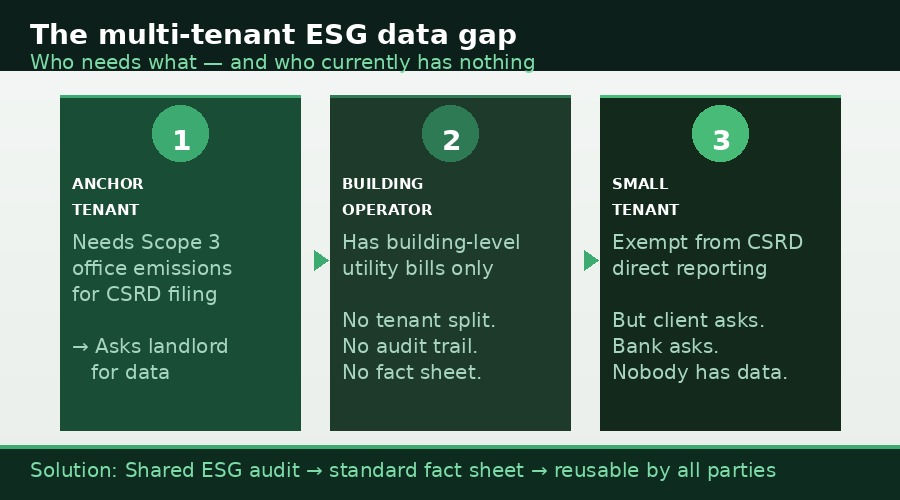
The landlord has building-level utility bills and an energy label C, required for all Dutch offices since 2023. But in a flex office where dozens of small businesses rent desks and rooms, nobody actually knows how much electricity or waste each tenant generates. Sub-meters cover some floors, not all. The cleaning crew invoices by building, not by client. Most licence agreements say nothing about data sharing.
This is not an unusual situation. It is the standard one.
On paper, many of those tenants are exempt from CSRD. Small and medium-sized businesses do not have to publish sustainability reports, even as reporting obligations for large and listed companies begin in 2025. In practice, those same tenants now sit inside portfolios and supply chains that do. Anchor tenants, investors, and lenders need ESG data that multi-tenant buildings were never designed to provide.
That gap, between what regulations assume and what buildings can actually deliver, is what this article is about. Shared ESG audits are one practical way to close it. one.
CSRD exemptions and the indirect pressure on flex offices
The CSRD requires large and listed companies to publish detailed sustainability information on environmental, social, and governance themes, specifically those most relevant to their business and stakeholders. In the Netherlands, the timeline rolls in stages: companies already subject to the Non-Financial Reporting Directive from 2025, other large companies from 2028, and listed SMEs from 2029.
Dutch government guidance is explicit that small and medium-sized businesses are exempt from direct CSRD obligations. The same guidance also notes that businesses working with large companies will be indirectly affected, as those customers push reporting demands down their value chains.
In commercial real estate and flexible offices, that value chain is unusually tangled. Landlords own buildings. Operators lease floors and sell memberships. Tenants range from freelancers to corporate project teams. Utilities and services are bundled into all-in prices. Yet the CSRD still expects someone to know how much energy a tenant uses, how waste is handled, and what the social and governance conditions are in that shared workspace.
The difficulty is well documented. Research published by the UK Green Building Council found that owners, operators, and developers of multi-tenant real estate consistently struggle to access reliable, granular ESG data. And that is because the process is typically carried out manually across multiple data sources, making it genuinely hard to understand where improvements can or should be made.
A tight office market only adds to the pressure: the same holds for the Dutch market. Companies looking for space that fits both their operational and sustainability requirements are already finding the options narrower than they expected.
Nobody has designed a system to answer those questions at the multi-tenant level. That is the problem this article addresses.
For operators who want the full picture of how these rules land in practice, our ESG compliance guidelines in the Netherlands article breaks down the expectations for SMEs and shared spaces.
Why can't flex offices just pull the data
The ESG challenge in multi-tenant buildings is mostly a data problem, and it takes a few familiar forms.
Siloed and incomplete data
Energy, water, waste, and indoor environment metrics sit across utility bills, building management systems, and service contracts, rarely in a format anyone can use for reporting. According to Cube Controls, a UK-based building management specialist, the difficulty for building operators lies not in understanding the frameworks but in collecting the right data consistently and reliably. In multi-tenant settings, that challenge multiplies with every additional occupier.
The sub-metering gap makes it worse. As energy platform Rhino has documented, missing sub-metering for tenants in multi-tenant buildings means consumption is routinely untracked, directly undermining accurate energy and emissions reporting. Most buildings allocate costs based on floor area or desk count, not actual consumption. That works for billing. It falls apart when an investor asks for verified emissions figures.
Manual processes and spreadsheets
Without automation, someone on the facilities team spends hours copying invoice numbers into spreadsheets every time a new questionnaire arrives. The figures are rough. They are rarely audit-ready. Research suggests data silos affect the vast majority of organisations handling ESG data, and that the problem is particularly acute in real estate portfolios where data flows in from dozens of disconnected systems simultaneously.
Tenant blind spots
Many multi-tenant buildings allocate costs based on floor area or desk count rather than actual use. That approach may work for billing but falls short for audit-ready ESG data, especially when regulators and stakeholders expect credible, verifiable emissions and waste figures.
Unclear roles and responsibilities
Standard Dutch office contracts focus on rent, fit-out obligations, and minimum energy performance requirements, including the energy label C requirement that has applied to all Dutch offices since 1 January 2023. According to the Netherlands Enterprise Agency (RVO), fewer than a third of Dutch office buildings met that standard as recently as mid-2020, which suggests how far behind the broader compliance infrastructure still is. Green lease clauses covering data sharing, waste separation, and joint reporting are only now beginning to appear in contracts. Most buildings are still operating on agreements that were never designed for this.
The result is a building full of businesses willing to improve, but without a shared system to do it with.
Why CSRD exemptions do not protect tenants in practice
From a small tenant's perspective, it is tempting to point to CSRD exemptions and move on. But exemptions from direct reporting do not mean immunity from questions. In practice, small and medium-sized tenants in co-working and flex offices are exposed in at least three ways.
Anchor tenants' reporting needs. Large occupiers preparing sustainability reports must disclose environmental themes such as energy use and emissions, even when working from shared buildings. They may request data from landlords or operators to calculate their share of building-level impacts, and may favour buildings where that data is ready.
Portfolio-level ESG assessments. Investors and developers increasingly use specialist ESG platforms to monitor building performance across multi-tenant real estate portfolios. Where tenant data cannot be captured reliably, overall scores and benchmarking suffer.
Rising expectations for SMEs. While CSRD initially targets large entities, EU and Dutch guidance on sustainability and value chains make clear that expectations for smaller businesses will increase over time. Flex tenants may not file their own reports, but they are increasingly visible in someone else's.
Without a more structured way to collect and share data across multi-tenant buildings, both landlords and tenants risk appearing opaque, even when they are genuinely willing to improve.
Shared ESG audits: a practical response for flex offices
One emerging solution is deceptively simple: treat co-working and flex offices as shared systems and run shared ESG audits that cover both building-level performance and typical tenant behaviour. Instead of asking each tenant to reinvent its own ESG baseline, landlords and operators can create a structured, repeatable view that everyone can use.
A solid shared audit covers three areas:
Building-level fundamentals. Energy label and performance, heating and cooling systems, lighting, building management systems, and sub-metering coverage.
Common services and waste streams. Cleaning, waste and recycling arrangements, shared facilities, and any currently installed metering.
Typical tenant profiles and activity patterns. Desk-based versus production activities, operating hours, and any high-intensity uses that materially affect consumption.
From there, operators can build standardised ESG fact sheets for the building, a document that includes energy and waste intensity per square metre or desk, key policies, and governance arrangements. Tenants can attach these to client questionnaires. Anchor tenants and investors get a consistent view of building performance.
Technology helps. Sub-meters connected to a unified data platform cut blind spots, speed up reporting, and usually surface wasted energy that operators can act on. But even without full digitalisation, a shared audit and a simple fact-sheet template can move a building from guessing to being credible in a few weeks.
Co-working operators: from landlords to ESG conveners
Operators sit between the building owner and the tenant. That turns out to be exactly where ESG data needs to be organised, and it opens a role that goes beyond renting desks.
In practice, acting as an ESG convener means three things:
Embedding ESG clauses in licence agreements and house rules. Clear expectations about data sharing, waste separation, and participation in building-level ESG initiatives provide a starting point for everyone.
Offering ESG starter packs to tenants. Small tenants rarely have the time or background to interpret CSRD developments for their own context. Pre-filled ESG building fact sheets and simple checklists can be the difference between a confident response and a missed client opportunity.
Coordinating joint improvements. Operators are well-placed to run building-wide actions, energy-saving campaigns, waste audits, and social initiatives that no individual tenant could manage on their own.
This is not a cost of doing business. Sustainability is already a factor in how corporate teams choose office space. Buildings that can show credible ESG data attract and keep the anchor tenants that flex operators depend on.
A practical roadmap for multi-tenant ESG readiness
For flex office operators, landlords, and asset managers who want to move from reactive to proactive, a realistic sequence looks like this.
Map your current data landscape. Identify what you already have: energy labels, utility bills, waste contracts, and building management system outputs. Note where data is missing for specific tenants or floors.
Define your stakeholders and their ESG expectations. List your anchor tenants, investors, and lenders and note which sustainability themes they prioritise: climate, energy, social conditions, or governance. Each group asks for something slightly different.
Conduct the first shared ESG audit for one pilot building. Start with your flagship site or the building where pressure is highest. Produce a standard ESG fact sheet. Use it to answer the next investor questionnaire, then adjust.
Introduce ESG clauses and tenant support as leases renew. Add data-sharing and ESG cooperation clauses gradually. Give tenants a simple document they can reuse. Most do not need a sustainability strategy; they need a one-page attachment for an email.
Plan for gradual digitalisation. Where budgets and the building allow, add sub-meters and connect them to a unified platform. The energy savings alone usually justify the cost faster than most people expect, and the reporting benefits come on top.
The goal is not to turn every co-working space into a data lab overnight. It is to move from ESG guesses to ESG systems, starting with the buildings and tenants where pressure and opportunity are highest.
Where a partner like Greennect fits in
For Dutch flex offices and multi-tenant operators, the problem is rarely about understanding regulations. It is about making them workable in shared, dynamic spaces. Greennect works specifically at this intersection: green workplaces, multi-tenant buildings, and ESG reporting that must function for both landlords and small tenants. This means that one of its core focus on ESG and green workplaces for small teams with limited time, including co-working spaces that need better data without more bureaucracy.
A typical engagement includes:
A co-working ESG audit that maps building-level performance and tenant realities without disrupting day-to-day operations.
Standard ESG fact sheets and evidence folders for each site, matched to what CSRD-reporting tenants, investors, and lenders actually ask for.
Short workshops or clinics for tenants to help them use the shared building data in their own client and bank questionnaires, without needing to become ESG experts. Most small tenants need thirty minutes and the right document.
The approach starts inside the building and works outward, rather than starting with frameworks and working inward. It is designed to take weeks, not months, and to work within existing staff capacity.
Three questions worth asking today
If you operate, own, or manage a co-working or multi-tenant office in the Netherlands, three questions tell you where you stand:
Can your anchor tenants get credible building-level energy and waste data today, the kind that holds up in a CSRD filing?
Do your lease or membership agreements include anything on ESG data sharing, waste practices, or joint sustainability actions?
Do you have even one building with a standard ESG fact sheet that tenants can attach to a client or lender questionnaire tomorrow?
A 'no' on any of those means the problem is already at your door. Greennect’s Co-Working ESG Snapshot starts with a short intake call and a high-level review of one building’s data reality, followed by a concrete proposal for a shared audit and tenant-ready documentation. It takes a few weeks and fits inside existing staff capacity.
Multi-tenant offices have a choice: stay an anonymous data gap in someone else's sustainability report, or become the building where ESG actually works for everyone inside it.


Comments