
ESG Reporting in 2026: A Guide for SMEs

Updated: Mar 23
ESG used to be a term that only seemed to matter to someone else.
In 2026, it is a spreadsheet on your desk, a question from your bank, and a line in your biggest client’s contract. New EU rules, stricter investors, and more attentive customers mean that even small firms now meet ESG in their inbox, not just in policy papers.
Regulatory update — March 2026
The Omnibus I Directive entered into force on 24 February 2026. The CSRD threshold has moved from 250 to 1,000 employees, removing most Dutch SMEs from mandatory reporting obligations entirely. If you were previously uncertain whether CSRD applied to you, it almost certainly no longer does.
What has not changed: your customers, banks, and landlords can still ask for ESG data whenever they want. The VSME standard is now the most relevant framework for Dutch SMEs responding to those requests. Everything in this article reflects that updated landscape.
ESG Reporting in 2026: What Has Changed
ESG reporting is now the way a company explains its environmental, social, and governance impact using clear, repeatable data. From 2026, more European companies must publish structured sustainability information under the Corporate Sustainability Reporting Directive (CSRD), and this pressure flows straight down their supply chains to smaller firms.
Large listed companies, banks, and some non-EU groups active in Europe are already reporting using European Sustainability Reporting Standards (ESRS). In practice, this means that even small and mid-sized enterprises (SMEs) will face detailed ESG questionnaires from customers, lenders, and investors in 2026.
Why ESG Metrics Now Matter for Every SME
In 2026, ESG is no longer just a branding exercise; it is tied to capital, risk, and market access. European ESG bond and loan volumes exceeded hundreds of billions of euros by late 2024, indicating that capital is actively seeking credible sustainability performance.
For SMEs, strong ESG metrics can:
Help keep key clients who must report on their value-chain emissions and social risks under the CSRD.
Improve access to bank finance, as lenders increasingly integrate ESG data into credit decisions and pricing.
Support talent attraction and retention, especially among younger workers who care about employer values.
Recent European research finds a positive link between higher ESG scores and better financial performance, measured by indicators such as return on assets and profitability. Good ESG reporting is therefore not a side project; it is part of long-term business value and resilience.
Frameworks and Rules Shaping ESG Reporting in 2026
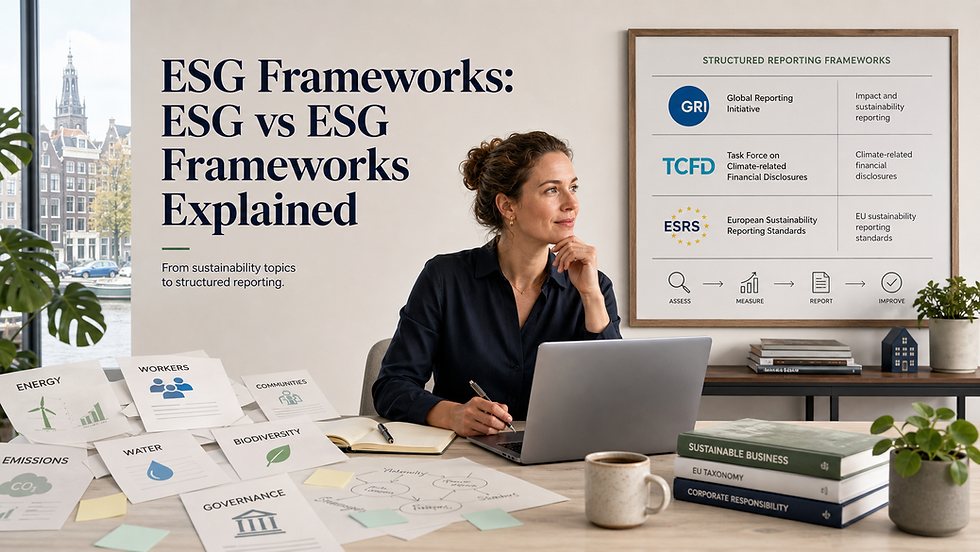
ESG reporting in 2026 is defined by a small group of powerful frameworks and legal standards. Understanding them helps you choose metrics and formulas that will still make sense in a few years.
Key Pillars
CSRD (Corporate Sustainability Reporting Directive): Expands detailed sustainability reporting obligations to approximately 50,000 companies across the EU, with a phased rollout over several reporting years.
ESRS (European Sustainability Reporting Standards): Set out the specific topics, disclosures, and data points large companies must report, including climate, pollution, workers, and governance.
VSME Standard: A voluntary, simplified ESG standard launched to help SMEs respond to data requests without adopting full ESRS complexity.
The VSME standard is especially important for smaller suppliers because it provides a structured yet realistic set of metrics and disclosures. Using it as a backbone makes it easier to plug your SME data into the systems used by large corporate customers.

The metrics Dutch SMEs actually get asked for
Most ESG guides hand you a list of 40+ indicators and tell you to pick what’s relevant. That’s not very helpful when you have six people in the office and a supplier questionnaire due Friday.
Here's what actually shows up in practice: the metrics that recur in Dutch bank ESG assessments (ING, Rabobank), customer tender forms, RVO subsidy applications, and landlord sustainability checks. If you track nothing else, track these.
Metric | What you are measuring | VSME module |
Scope 1 emissions | Direct emissions from your own operations (gas heating, company vehicles) | Basic |
Scope 2 emissions | Indirect emissions from purchased electricity | Basic |
Energy consumption | Total kWh used per year, split by source | Basic |
Waste generated | Total kg of waste, split by type (recycled vs landfill) | Basic |
Staff headcount | Total employees, full-time equivalent | Basic |
Employee turnover rate | % of staff who leave per year | Basic |
Gender breakdown | % of women in the total workforce and in management roles | Basic |
Training hours | Average hours of training per employee per year | Comprehensive |
Written ESG policy | Whether you have a documented approach to at least one ESG topic | Basic |
Anti-corruption policy | Whether a written policy exists and has been communicated to staff | Basic |
The Basic module covers the first seven of these. If you are responding to a bank or large corporate buyer, they will typically want at least the Basic set plus a written policy. The Comprehensive module adds climate risk and supply chain disclosures, worth doing if you are a regular supplier to a large listed company.
Who asks for what
Knowing which metric gets requested where saves you from tracking things nobody will ever check.
Banks (ING, Rabobank, ABN AMRO ESG loan criteria): Energy consumption, Scope 1 and 2 emissions, and evidence of a written environmental or ESG policy are the most common asks. Some also request employee turnover and gender data as social indicators.
Customer tender forms and procurement questionnaires: an anti-corruption policy, a written ESG policy, and a summary emissions figure are near-universal. Larger corporates increasingly ask for Scope 2 data and evidence of training on sustainability topics.
RVO and public sector procurement: Energy consumption, waste data, and confirmation of ISO 14001 or equivalent (or a written substitute if you don’t have certification).
Landlords and co-working operators: Energy intensity per m², waste handling procedures, and whether you track your own consumption separately from shared building meters.
If a metric doesn't appear in any of the above, it's probably not worth prioritising for a Dutch SME with fewer than 50 staff right now.
Environmental Metrics: Simple 2026-Ready Formulas
Environmental metrics track how your operations affect climate, energy, water, and waste. In 2026, buyers and lenders will expect at least basic climate and resource data from serious suppliers.
1. Greenhouse Gas Emissions (Scope 1 and 2)
Scope 1: Direct fuel use (company vehicles, on-site combustion).
Scope 2: Purchased electricity and heat.
Basic Formula for a Fuel Type:
- Emissions (tonnes CO₂e) = Fuel used × Emission factor.
- Example: 10,000 litres of diesel × 2.68 kg CO₂e per litre ≈ 26.8 tonnes CO₂e.
2. Carbon Intensity per Euro of Revenue
Formula:
- Carbon intensity = Total emissions (tonnes CO₂e) ÷ Annual revenue (euros).
This allows you to show improvement even when turnover grows, which is key for SMEs with rising sales.
3. Energy Consumption and Intensity
Track electricity and gas use in kilowatt-hours (kWh) per year.
Formula for Intensity:
- Energy intensity = Total energy use (kWh) ÷ Floor area (m²) or ÷ Number of employees.
4. Water and Waste Metrics
Track cubic metres of water and tonnes of waste per year.
Formula for Recycling Rate:
- Recycling rate (%) = (Recycled waste ÷ Total waste) × 100.
Track your key ESG numbers in one place with our environment dashboard for SMEs, designed for simple monthly updates.
What reasonable numbers look like for a Dutch office SME
Formulas are only useful if you have some sense of what the result should look like. These are rough reference ranges for a typical Dutch office-based SME with 10–50 staff, based on published benchmarks from the Netherlands Enterprise Agency (RVO) and Dutch energy consumption data.
Energy intensity: 100–180 kWh/m² per year for a standard Dutch office building. If you are above 200, there's usually a quick win available (lighting, heating controls, equipment standby settings).
Scope 2 emissions: For a fully electric office on average Dutch grid mix (2025 figures), roughly 0.27 kg CO₂ per kWh. If you are on a 100% renewable tariff with Guarantees of Origin, you can report zero for Scope 2.
Staff turnover: the average for Dutch SMEs sits at 15–20% per year across sectors. Above 25% is worth investigating and should be flagged honestly in a questionnaire rather than left blank.
Gender in management: The Dutch national average for women in senior roles across SMEs is around 30%. Banks and buyers rarely set a target at this stage; they are mostly checking whether you have thought about it.
Training hours: 20–30 hours per employee per year is a reasonable floor for most service-sector SMEs. Manufacturing and logistics typically run higher.
These are not targets. They are reference points to help you determine whether your numbers look plausible before you submit them.
Social Metrics: People, Safety, and Inclusion
Social metrics say how you treat employees, contractors, and communities. In 2026, many ESG questionnaires give equal weight to workers’ rights and safety as to emissions.
1. Employee Turnover Rate
Formula:
- Turnover (%) = (Number of leavers in year ÷ Average number of employees) × 100.
High turnover can signal poor working conditions or a weak culture, and buyers are paying attention.
2. Lost Time Injury Frequency Rate (LTIFR)
Formula:
- LTIFR = (Number of lost time injuries × 1,000,000) ÷ Total hours worked.
Using this standard formula lets clients compare safety performance fairly across suppliers.
3. Diversity Indicators
Example: Share of women in management.
Formula:
- Share (%) = (Number of women in management ÷ Total managers) × 100.
Other indicators can mirror your context, such as age mix, migrant workers, or part-time versus full-time employees.
4. Training and Development
Formula:
- Training hours per employee = Total training hours ÷ Number of employees.
This simple figure shows whether you invest in skills and long-term competence.
Want to see how this looks in practice? Visit our Knowledge Centre page for real examples and simple ideas you can adapt.
Governance Metrics: How You Make Decisions
Governance metrics reveal how decisions are made, how risks are controlled, and how ethical behaviour is enforced. In a 2026 context, governance has moved beyond box-ticking to evidence of real oversight and accountability.
1. Leadership or Board Independence
Metric: Share of independent members on your board or advisory group.
Formula:
- Independence (%) = (Independent members ÷ Total members) × 100.
2. Code of Conduct Coverage
Metric: Share of staff and key suppliers who have signed your code of conduct.
Formula:
- Coverage (%) = (Number who signed ÷ Total targeted staff or suppliers) × 100.
3. Ethics and Compliance Incidents
Metric: Number of confirmed breaches per year (fraud, harassment, bribery).
Normalised Figure:
- Incidents per 100 employees = (Number of incidents ÷ Total employees) × 100.
4. ESG-Linked Variable Pay
Metric: Share of bonuses or variable pay tied to ESG targets.
Formula:
- ESG-linked pay (%) = (ESG-linked bonus ÷ Total variable pay) × 100.
For practical next steps, explore the OECD governance principles as a clear global benchmark to measure yourself against.
What to skip for now
ESG frameworks are written for every type of organisation simultaneously, which means they include a lot of things that simply don’t apply to a 15-person Dutch SME. Tracking the wrong metrics wastes time and sometimes makes questionnaire responses look worse, not better (blank fields and "not applicable" answers can raise flags if the metric was never relevant in the first place).
Things you can safely deprioritise until you have the basics covered:
Scope 3 emissions (full value chain): Relevant for manufacturers or logistics firms with complex supply chains. For an office-based SME, Scope 1 and 2 tell the story. The VSME standard lists Scope 3 as an optional disclosure, not a required one.
Biodiversity metrics: Unless your operations directly affect land use or natural habitats, skip it. A fintech in Rotterdam tracking biodiversity indicators looks like ticking boxes rather than genuine disclosure.
Community investment/social value metrics: These matter to large companies with a visible local impact. For most SMEs, a written commitment to fair pay and safe working conditions covers the same ground more credibly.
Board composition and executive pay ratios: Governance metrics for a company with a three-person leadership team. Buyers and banks know this; they are not expecting a governance committee.
Water consumption: Worth tracking if you are in food production, manufacturing, or a water-intensive sector. For a standard office, it’s rarely asked for and rarely material.
The principle: report what’s real for your business. A short, honest set of metrics you can stand behind is worth more than a long list of approximations.
ESG, Profit, and Access to Finance in 2026
The core question for many business owners is still simple: Does ESG pay? Across several European studies, firms with stronger ESG scores and better disclosure tend to show higher profitability and asset returns than peers with weak ESG performance.
Investors and banks use ESG data as a proxy for management quality, foresight, and risk control. For SMEs, this can translate into better access to credit, preferential terms for ESG-linked loans, and a stronger appeal to impact-oriented investors or public funds.
By 2026, many corporate buyers must report on Scope 3 emissions and social risks in their value chains. Suppliers who can provide reliable, formula-based ESG metrics will have a clear edge over those who respond late or with vague narratives.
Practical Next Steps for 2026
Stepping into ESG reporting in 2026 does not require a legal department or a room of consultants. It requires choosing a small set of honest, repeatable metrics and calculating them using clear formulas.
Where to start
If you are looking at this for the first time, the order matters more than the volume.
Start with the Basic VSME set: Scope 1 and 2 emissions, energy consumption, headcount, turnover rate, and a written ESG policy. These cover roughly 80% of what any Dutch bank or buyer will ask for in 2026. You can collect most of it from your energy bills, HR records, and one afternoon of documentation.
Once those are in place, add the Comprehensive module metrics if you regularly respond to large corporate buyers: training hours, a climate risk summary, and a basic supply chain statement.
Don't wait until you have perfect data. Questionnaires that show partial data with honest notes ("we began tracking this in Q1 2026") read better than blanks or estimates presented as facts.
If you want a ready-made folder structure, trackers, and support for completing your first questionnaire, that's what Greennect's Starter Compliance Pack is built for.
Or if you are not sure, a simple place to start is to contact us through the Greennect Mini Audit form and select 5–10 core indicators for your business. Once you are ready to go deeper, explore 2026 Sustainability Reporting Trends to see how these metrics fit into the broader picture and what your next steps should be.


Comments